Read a Clockwork Orange Online for Free
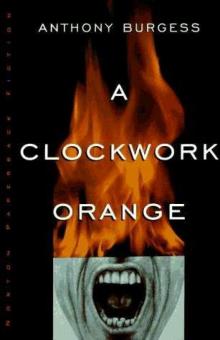
Anthony Burgess has been called one of the very few literary geniuses of our time. Certainly he borrowed from no other literary source than himself. That source produced thirty-two novels, a volume of verse, two plays, and sixteen works of nonfiction--together with countless musical compositions, including symphonies, operas, and jazz. His nearly recent work was A Mouthful of Air: Language, Languages . . . Particularly English. Anthony Burgess died in 1993.
Other works by Anthony Burgess available from Norton:
The Medico Is Ill
Honey for the Bears
The Long Twenty-four hours Wanes: A Malayan Trilogy
Aught Like the Sun
Re Joyce
The Wanting Seed
A
Clockwork
Orange
Anthony Burgess
Due west. W. NORTON & COMPANY
NEW YORK LONDON
Contents
Begin Reading
Introduction
A Clockwork Orange Resucked
I first published the novella A Clockwork Orangish in 1962, which ought to exist far plenty in the by for it to be erased from the globe's literary retentiveness. It refuses to be erased, however, and for this the film version of the book made by Stanley Kubrick may be held chiefly responsible. I should myself be glad to disown information technology for various reasons, but this is not permitted. I receive mail from students who endeavor to write theses nigh it, or requests from Japanese dramaturges to plough it into a sort of Noh play. It seems likely to survive, while other works of mine that I value more seize with teeth the dust. This is non an unusual experience for an artist. Rachmaninoff used to groan because he was known mainly for a Prelude in C Sharp Minor which he wrote every bit a boy, while the works of his maturity never got into the programmes. Kids cut their pianistic teeth on a Minuet in G which Beethoven equanimous only and then that he could detest it. I have to proceed living with A Clockwork Orange, and this ways I have a sort of authorial duty to it. I have a very special duty to it in the Us, and I had better now explain what this duty is.
Let me put the state of affairs baldly. A Clockwork Orange has never been published entire in America. The book I wrote is divided into iii sections of vii chapters each. Take out your pocket calculator and y'all volition find that these add up to a full of twenty-i chapters. 21 is the symbol of human maturity, or used to be, since at 21 you got the vote and assumed developed responsibleness. Whatever its symbology, the number 21 was the number I started out with. Novelists of my postage are interested in what is called arithmology, meaning that number has to mean something in human terms when they handle it. The number of chapters is never entirely arbitrary. Only equally a musical composer starts off with a vague image of bulk and elapsing, so a novelist begins with an epitome of length, and this prototype is expressed in the number of sections and the number of chapters into which the piece of work will be tending. Those 20-one chapters were important to me.
Simply they were not important to my New York publisher. The book he brought out had only twenty capacity. He insisted on cutting out the xx-first. I could, of course, have demurred at this and taken my volume elsewhere, only it was considered that he was being charitable in accepting the work at all, and that all other New York, or Boston, publishers would kick out the manuscript on its dog-ear. I needed money back in 1961, even the pittance I was existence offered as an advance, and if the condition of the book's acceptance was also its truncation--well, so be information technology. And then in that location is a profound difference betwixt A Clockwork Orange every bit Swell Britain knows it and the somewhat slimmer volume that bears the same name in the Usa.
Let us become further. The rest of the globe was sold the volume out of Swell Britain, and so nearly versions--certainly the French, Italian, Castilian, Catalan, Russian, Hebrew, Rumanian, and German translations--have the original twenty-ane chapters. At present when Stanley Kubrick made his film--though he made it in England--he followed the American version and, so it seemed to his audiences outside America, concluded the story somewhat prematurely. Audiences did not exactly clamour for their money back, just they wondered why Kubrick left out the denouement. People wrote to me almost this--indeed much of my later life has been expended on Xeroxing statements of intention and the frustration of intention--while both Kubrick and my New York publisher coolly bask in the rewards of their misdemeanour. Life is, of grade, terrible.
What happens in that twenty-first chapter? You now have the chance to find out. Briefly, my young thuggish protagonist grows up. He grows bored with violence and recognises that human being energy is better expended on creation than destruction. Senseless violence is a prerogative of youth, which has much free energy simply piffling talent for the effective. Its dynamism has to find an outlet in bang-up telephone kiosks, derailing trains, stealing cars and neat them and, of course, in the much more than satisfactory activity of destroying man beings. There comes a time, however, when violence is seen equally juvenile and boring. It is the repartee of the stupid and ignorant. My young hoodlum comes to the revelation of the need to become something washed in life--to marry, to afford children, to keep the orange of the world turning in the rookers of Bog, or hands of God, and mayhap even create something--music, say. Afterward all, Mozart and Mendelssohn were composing deathless music in their teens or nadsats, and all my hero was doing was razrezzing and giving the erstwhile in-out. It is with a kind of shame that this growing youth looks back on his devastating by. He wants a different kind of future.
In that location is no hint of this change of intention in the twentieth affiliate. The boy is conditioned, then deconditioned, and he foresees with glee a resumption of the functioning of free and vehement volition. 'I was cured all right,' he says, and so the American volume ends. So the film ends too. The twenty-first chapter gives the novel the quality of genuine fiction, an art founded on the principle that man beings change. In that location is, in fact, not much point in writing a novel unless you can prove the possibility of moral transformation, or an increase in wisdom, operating in your chief grapheme or characters. Even trashy bestsellers show people irresolute. When a fictional work fails to evidence change, when it merely indicates that man graphic symbol is fix, stony, unregenerable, then you lot are out of the field of the novel and into that of the fable or the allegory. The American or Kubrickian Orangish is a fable; the British or world one is a novel.
But my New York publisher believed that my twenty-offset chapter was a sellout. It was veddy veddy British, don't you know. It was bland and it showed a Pelagian unwillingness to accept that a man could be a model of unregenerable evil. The Americans, he said in effect, were tougher than the British and could face up to reality. Presently they would be facing up to it in Vietnam. My book was Kennedyan and accepted the notion of moral progress. What was really wanted was a Nixonian book with no shred of optimism in it. Let united states have evil prancing on the page and, up to the very final line, sneering in the confront of all the inherited beliefs, Jewish, Christian, Muslim and Holy Roller, near people being able to make themselves meliorate. Such a book would exist sensational, and then it is. Merely I do not remember information technology is a off-white picture of human life.
I do non think and then because, by definition, a human beingness is endowed with gratuitous will. He tin use this to choose between good and evil. If he can only perform skilful or only perform evil, then he is a clockwork orange--meaning that he has the appearance of an organism lovely with colour and juice but is in fact only a clockwork toy to exist wound up past God or the Devil or (since this is increasingly replacing both) the Almighty Country. It is as inhuman to exist totally skilful as it is to be totally evil. The important thing is moral choice. Evil has to exist along with good, in order that moral choice may operate. Life is sustained by the grinding opposition of moral entities. This is what the television set news is all about. Unfortunately there is so much original sin in usa all that nosotros find evil rather attractive. To devastate is easier and more than sp
ectacular than to create. Nosotros similar to accept the pants scared off the states past visions of cosmic devastation. To sit down in a ho-hum room and compose the Missa Solemnis or The Anatomy of Melancholy does not brand headlines or news flashes. Unfortunately my little squib of a book was found bonny to many because it was equally odorous as a crateful of bad eggs with the miasma of original sin.
It seems priggish or pollyannaish to deny that my intention in writing the work was to titillate the nastier propensities of my readers. My ain healthy inheritance of original sin comes out in the volume and I enjoyed raping and ripping by proxy. It is the novelist'due south innate cowardice that makes him depute to imaginary personalities the sins that he is too cautious to commit for himself. Simply the volume does too accept a moral lesson, and it is the weary traditional one of the cardinal importance of moral choice. Information technology is considering this lesson sticks out like a sore thumb that I tend to disparage A Clockwork Orange as a work too didactic to be artistic. It is not the novelist's job to preach; information technology is his duty to show. I accept shown enough, though the curtain of an invented lingo gets in the fashion--another aspect of my cowardice. Nadsat, a Russified version of English, was meant to conceal the raw response we expect from pornography. It turns the book into a linguistic chance. People preferred the moving picture because they are scared, rightly, of language.
I don't call back I accept to remind readers what the championship means. Clockwork oranges don't exist, except in the oral communication of sometime Londoners. The paradigm was a baroque i, e'er used for a bizaare matter. "He's equally queer as a clockwork orange" meant he was queer to the limit of queerness. It did not primarily announce homosexuality, though a queer, before restrictive legislation came in, was the term used for a fellow member of the inverted fraternity. Europeans who translated the title as Arancia a Orologeria or Orange Mecanique could not empathise its Cockney resonance and they causeless that it meant a manus grenade, a cheaper kind of explosive pineapple. I mean it to represent the application of a mechanistic morality to a living organism oozing with juice and sweetness.
Readers of the twenty-first chapter must decide for themselves whether it enhances the book they presumably know or is really a discardable limb. I meant the book to end in this way, only my aesthetic judgement may have been faulty. Writers are rarely their ain all-time critics, nor are critics. "Quod scripsi scripsi" said Pontius Pilate when he made Jesus Christ the King of the Jews. "What I accept written I have written." We tin destroy what we have written only we cannot unwrite it. I leave what I wrote with what Dr. Johnson called frigid indifference to the sentence of that .00000001 of the American population which cares near such things. Eat this sweetish segment or spit information technology out. You are complimentary.
NOVEMBER 1986
Part One
1
'What'south information technology going to be then, eh?'
There was me, that is Alex, and my iii droogs, that is Pete, Georgie, and Dim, Dim being actually dim, and we sabbatum in the Korova Milkbar making up our rassoodocks what to do with the evening, a flip dark chill winter bounder though dry. The Korova Milkbar was a milk-plus mesto, and you may, O my brothers, have forgotten what these mestos were like, things irresolute then skorry these days and everybody very quick to forget, newspapers non being read much neither. Well, what they sold there was milk plus something else. They had no licence for selling liquor, but there was no law nevertheless confronting prodding some of the new veshches which they used to put into the onetime moloko, so you could peet it with vellocet or synthemesc or drencrom or one or two other veshches which would give you a nice quiet horrorshow fifteen minutes admiring Bog And All His Holy Angels And Saints in your left shoe with lights bursting all over your mozg. Or you could peet milk with knives in it, as we used to say, and this would acuminate you up and make you lot ready for a bit of dirty xx-to-i, and that was what nosotros were peeting tonight I'm starting off the story with.
Our pockets were full of deng, so at that place was no real need from the point of view of crasting whatever more than pretty polly to tolchock some erstwhile veck in an alley and viddy him swim in his blood while nosotros counted the takings and divided past iv, nor to do the ultra-violent on some shivering starry grey-haired ptitsa in a shop and become smecking off with the till's guts. But, every bit they say, money isn't everything.
The four of us were dressed in the heighth of mode, which in those days was a pair of black very tight tights with the old jelly mould, equally nosotros called information technology, fitting on the crutch underneath the tights, this being to protect and also a sort of a design you could viddy clear enough in a certain low-cal, so that I had 1 in the shape of a spider, Pete had a rooker (a paw, that is), Georgie had a very fancy one of a flower, and poor old Dim had a very hound-and-horny ane of a clown'southward litso (face up, that is), Dim non e'er having much of an thought of things and beingness, beyond all shadow of a doubting thomas, the dimmest of we four. Then nosotros wore waisty jackets without lapels but with these very big congenital-up shoulders ('pletchoes' we chosen them) which were a kind of a mockery of having real shoulders like that. Then, my brothers, we had these off-white cravats which looked similar whipped-up kartoffel or murphy with a sort of a design made on it with a fork. We wore our pilus not as well long and we had flip horrorshow boots for kicking.
'What'due south it going to exist then, eh?'
There were three devotchkas sitting at the counter all together, only there were four of us malchicks and information technology was usually similar ane for all and all for one. These sharps were dressed in the heighth of fashion besides, with purple and dark-green and orange wigs on their gullivers, each one non costing less than three or 4 weeks of those sharps' wages, I should reckon, and brand-up to match (rainbows round the glazzies, that is, and the rot painted very wide). Then they had long black very straight dresses, and on the groody function of them they had footling badges of like silver with unlike malchicks' names on them--Joe and Mike and suchlike. These were supposed to be the names of the different malchicks they'd spatted with before they were 14. They kept looking our way and I near felt similar saying the 3 of usa (out of the corner of my rot, that is) should become off for a scrap of political leader and leave poor old Dim behind, because information technology would be just a matter of kupetting Dim a demi-litre of white only this time with a dollop of synthemesc in it, but that wouldn't really have been playing like the game. Dim was very very ugly and similar his proper noun, merely he was a horrorshow filthy fighter and very handy with the boot.
'What's it going to be then, eh?'
The chelloveck sitting adjacent to me, there being this long big plushy seat that ran circular iii walls, was well abroad with his glazzies glazed and sort of burbling slovos like 'Aristotle wishy washy works outing cyclamen get forficulate smartish'. He was in the land all right, well away, in orbit, and I knew what it was similar, having tried information technology like everybody else had done, but at this fourth dimension I'd got to thinking it was a cowardly sort of a veshch, O my brothers. You'd lay there after you'd drunkard the old moloko and then yous got the messel that everything all round you was sort of in the past. You lot could viddy information technology all right, all of it, very clear--tables, the stereo, the lights, the sharps and the malchicks--but it was similar some veshch that used to exist there but was not there not no more. And y'all were sort of hypnotized by your boot or shoe or a finger-nail as it might be, and at the same fourth dimension you were sort of picked up by the one-time scruff and shook like it might be a cat. You got shook and shook till in that location was nix left. You lost your proper noun and your trunk and your self and you lot just didn't care, and you waited till your boot or your finger-boom got yellow, and then yellower and yellower all the fourth dimension. Then the lights started corking like atomics and the kick or finger-nail or, equally it might be, a scrap of dirt on your trouser-bottom turned into a large big big mesto, bigger than the whole world, and you were just going to get introduced to onetime Bog or God when information technology was all over. You came dorsum to here and now whimpering sort of, with your rot all squaring upwards for a boohoohoo. At present, that'southward very nice but very cowardly. You were not put on this earth just to get in bear on with God. That sort of thing could sap all the strength and the goodness out of a chelloveck.
'What'due south it going to exist and then, eh?'
The stereo was on and y'all got the idea that the singer's goloss was moving from
one part of the bar to another, flying up to the ceiling and and then swooping down again and whizzing from wall to wall. It was Berti Laski rasping a real starry oldie chosen 'You Blister My Pigment'. One of the 3 ptitsas at the counter, the one with the green wig, kept pushing her abdomen out and pulling it in in time to what they chosen the music. I could feel the knives in the sometime moloko starting to prick, and now I was ready for a bit of twenty-to-one. So I yelped: 'Out out out out!' similar a doggie, and then I cracked this veck who was sitting next to me and well abroad and burbling a horrorshow crevice on the ooko or earhole, merely he didn't experience it and went on with his 'Telephonic hardware and when the farfarculule gets rubadubdub'. He'd experience information technology all right when he came to, out of the land.
'Where out?' said Georgie.
'Oh, simply to go on walking,' I said, 'and viddy what turns up, O my niggling brothers.'
So we scatted out into the big winter nochy and walked down Marghanita Boulevard and then turned into Boothby Artery, and there nosotros found what we were pretty well looking for, a malenky jest to showtime off the evening with. There was a doddery starry schoolmaster type veck, glasses on and his rot open to the common cold nochy air. He had books under his arm and a crappy umbrella and was coming round the corner from the Public Biblio, which not many lewdies used those days. Y'all never really saw many of the older conservative blazon out afterward nightfall those days, what with the shortage of constabulary and we fine young malchickiwicks about, and this prof type chelloveck was the merely ane walking in the whole of the street. And then we goolied up to him, very polite, and I said: 'Pardon me, brother.'
He looked a malenky bit poogly when he viddied the four of us like that, coming up then tranquillity and polite and smiling, but he said: 'Yes? What is it?' in a very loud teacher-blazon goloss, every bit if he was trying to show the states he wasn't poogly. I said:
'I run into you have books under your arm, brother. It is indeed a rare pleasure these days to come up beyond somebody that however reads, blood brother.'
Source: https://onlinereadfreenovel.com/anthony-burgess/31885-a_clockwork_orange.html
Belum ada Komentar untuk "Read a Clockwork Orange Online for Free"
Posting Komentar